LocalLeadOps: A Workflow Teardown
The product felt commercially clean until the real chokepoint emerged: the part that looked most valuable was the part I could not responsibly automate.
I want to write this down while the whole thing is still fresh.
LocalLeadOps was one of those ideas that felt almost suspiciously clean when I first saw it. I had asked ChatGPT for business ideas that fit a narrow set of constraints I actually live with. I was not looking for the most exciting business in the abstract. I was looking for something I could plausibly start.
The constraints were pretty simple.
- Low physical demand
- Low capital
- Remote-friendly
- Fast to launch
LocalLeadOps came back as one of the stronger ideas. The pitch was straightforward. A lot of small service businesses miss calls because the owner is also the worker. If a landscaper, cleaner, handyman, or detailer is out doing the job, they are not always in a position to answer the phone. That means leads leak out of the business in a very ordinary way. No one is making a strategic mistake. They are just busy.
That felt real immediately. I could picture the operator, the missed call, and the lead moving on to the next business on Google. The value proposition was simple enough that I thought I could package it and sell it.
What I thought I was building

The core idea was to help local service businesses turn missed calls into bookings.
At the beginning, the product thesis seemed obvious. If a business misses a call from a prospective customer, you respond instantly by text. If there is no response, you send a day-1 follow-up. If there is still no response, you send a day-3 follow-up. That was the basic chain.
It sounds good because it fits the actual shape of the problem.
The owner misses the call because they are working. The lead still needs help. The lead is often ready to move quickly. The business needs some kind of immediate acknowledgment layer.
I did not think the magic was in AI itself. The magic, if there was any, was in putting a very simple response system in the gap between the missed call and the lost lead.
The more I thought about it, the more it seemed like a good first business. It had a clear niche. It had a clear pain point. It had low implementation complexity, at least on the surface. It sounded like something a service business owner could understand in one sentence.
We help you recover missed calls so more of them turn into booked jobs.
That is a real sentence. It does not need any startup theater around it.
What I built
Once I got moving, I built a lot faster than I would have without AI.
That is part of why I think this project is worth writing about. AI made the build phase feel smooth enough that it was easy to confuse shipping momentum with business validity.
I built out positioning, outreach scripts, onboarding materials, a landing page, and an operational workflow. The whole system came together fast. There was a starter pack, a CSV-based workflow for prospects and follow-ups, daily execution tooling, scorecards, and enough structure around the idea that it started to feel complete.
I also built the landing page.
That was one of the more satisfying parts of the process. I had screenshots of attractive landing pages from Behance, and with AI help I was able to turn those references into something presentable quickly. It was not perfect. It was presentable enough that the idea started to feel like a business and not just a folder of notes.
The source inspiration was by Abu Jar Gifari on Behance. He has a real gift for clean composition and visual hierarchy, and that made it much easier to steer the AI toward something coherent.
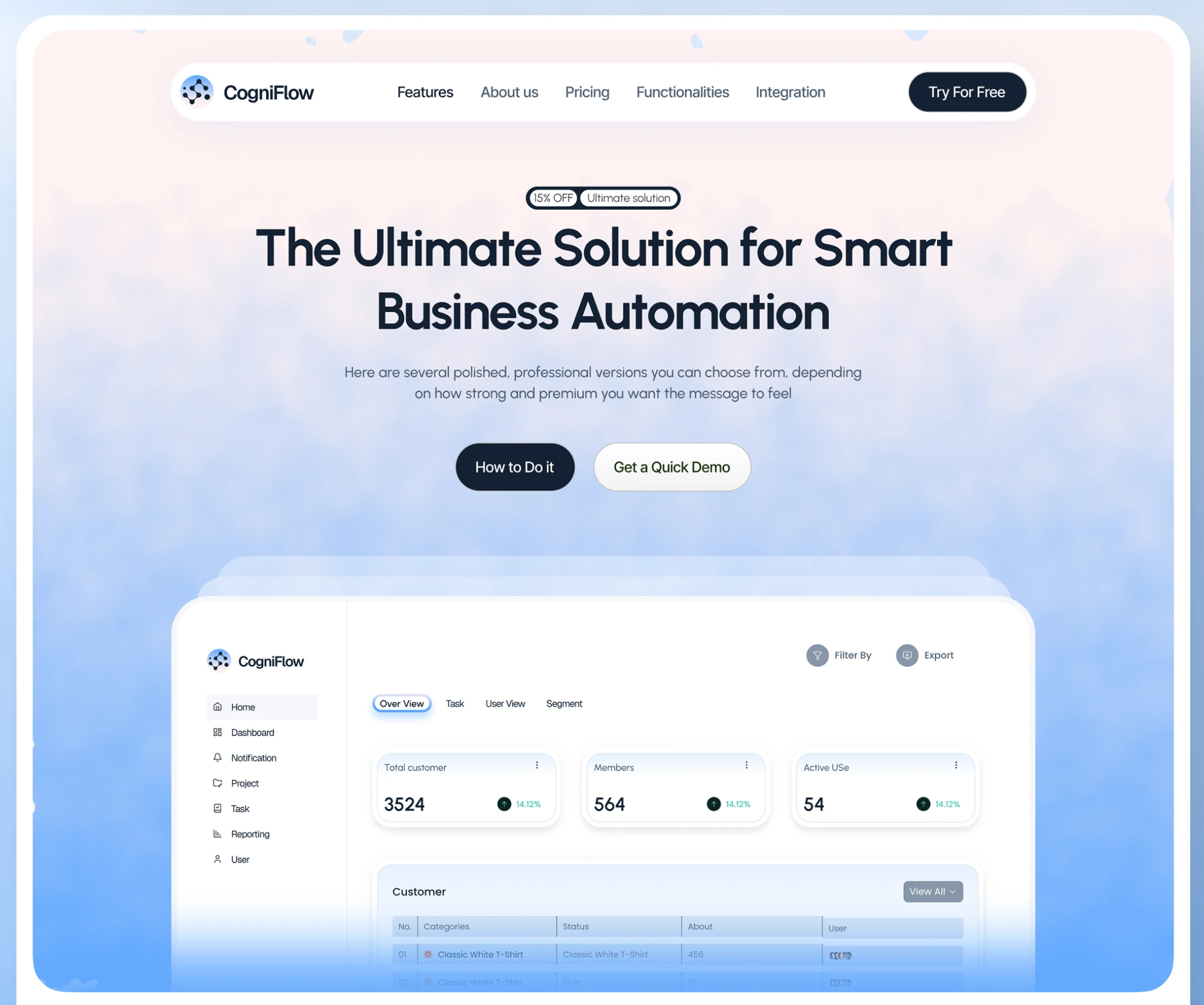
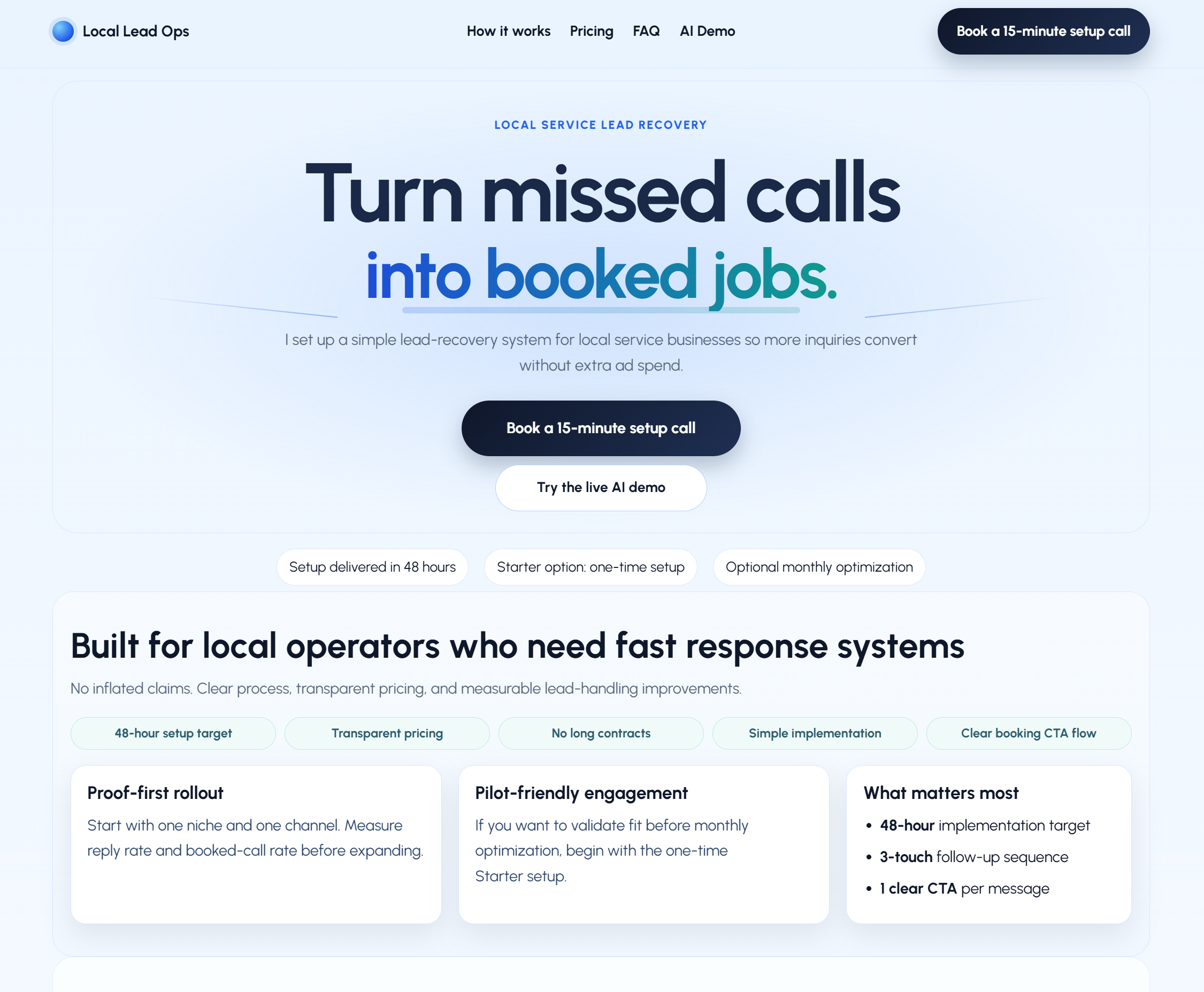
By that point, LocalLeadOps had become more than a business idea. It had the beginnings of a system around it.
The repo tells the story of that momentum pretty clearly. First came the landing page. Then the copy got cleaner. Then the automation layer became more stateful. Then the onboarding and SMS materials got more concrete. It looked like the normal progression of an idea getting more real.
That is the part AI is very good at enabling. Once the thesis looked coherent, it became easy to keep pushing it forward.
Where it broke
The break did not happen because I could not build the thing.
It broke because the exact version of the thing that seemed commercially strongest turned out to be the version that was hardest to justify legally and operationally.
The first blow was realizing that the three-text follow-up chain depended on consent that often would not exist.
That matters because the actual wedge was not website leads. Website leads were never the most compelling version of this. If someone is already filling out a website form, then the business at least has structured contact information and some kind of established lead capture flow. You can add consent language there. You can build follow-up around it. It is not nothing, but it is also not the sharpest pain point.
The sharp pain point is missed inbound calls.
That was the whole reason the idea was appealing in the first place.
But that is also where the consent problem shows up most clearly. If an unknown number calls a service business and the business misses the call, there is no prior website form, no checkbox, no stored text consent. There is only the fact of the missed call.
At first I thought that might still be enough for a practical missed-call recovery workflow. One immediate text-back felt like common sense. Maybe one or two follow-ups if there was no reply. That was the intuition.
Then the research got tighter.
The first problem was conceptual. Even if website-form consent could support a multi-text follow-up sequence, that still was not solving the core business problem I cared about. The business problem was the missed call from someone who had not filled out anything.
The second problem was legal and platform-specific.
The FCC side made the picture worse. The one-to-one consent rule and the tightening around seller-specific consent made it harder to tell a clean story about broad texting permission. The revocation rules made it clear that even if you tried to stay conservative, you were walking into a heavily regulated channel.
Then Twilio was the coup de grace.
By the time I got to their messaging policy in detail, the clean version of the product had basically collapsed. As of April 9, 2026, Twilio's policy requires prior express written consent for any messages sent through Twilio, including informational messages, and says that even when an individual initiates a message exchange, that does not create consent for ongoing recurring engagement. That was far tighter than the business logic I had built around. The strongest, most obvious behavior from a business perspective was no longer something I felt comfortable describing as safe by default. Even the conservative version of the automation started to look gray. That was the moment where the idea stopped feeling like a product I could responsibly package and sell.
The pain point was real. The problem was that the strongest automation wedge relied on a permissions model that did not line up with how the leads actually arrive.
That is a structural problem, not a copy problem.
Why that killed the business
Once that clicked, the whole offer changed shape.
If I could not confidently say, "we automatically recover missed calls with a 3-step text sequence," then the core value proposition lost a lot of its sharpness.
Could I still build something around callback workflow, lead triage, and immediate acknowledgment? Yes.
Could I still justify a one-off missed-call text-back in some contexts? Maybe.
Could I still automate website-form follow-up where explicit consent had been captured? Yes, probably.
But that was not the same business.
The exciting version of LocalLeadOps was that it appeared to solve the missed-call problem directly. Once I had to start qualifying the promise, the wedge narrowed.
The business became less like:
we turn missed calls into bookings
and more like:
we help you manage inbound leads with a combination of workflow, callback handling, selective automation, and careful consent boundaries
That business might still be useful. It is just a different business. It is slower to explain, harder to sell, and less obviously tied to the moment of pain.
In other words, the market was real, but the implementation thesis was wrong.
That is the sentence I keep coming back to.
What I would do differently
If I were starting over in the local services space, I would still pay attention to missed calls. I just would not build the business around an assumed texting sequence.
I would treat missed-call recovery as a workflow problem first and an automation problem second.
That means I would look more seriously at:
- callback queue management
- lead routing
- after-hours response handling
- inbox consolidation
- human follow-up support
- intake forms that create future consent properly
SMS would still be part of the picture. It just would not be the whole thesis.
I also would be much more aggressive, much earlier, about pressure-testing the legal and platform constraints of the exact default behavior I wanted to sell.
That is probably the biggest lesson here.
AI makes it easy to run far ahead on implementation. You can go from idea to landing page to ops workflow to onboarding materials very quickly. That speed is real and useful. I do not want to undersell it. This project was exciting and honestly fun to build. It felt good to turn a rough idea into something with structure and momentum.
But speed creates a new kind of failure mode. You can build out the support structure of a business before you have fully tested the narrow chokepoint that the whole business depends on.
That is what happened here.
The chokepoint was never the scripts, the landing page, or the offer packaging.
The chokepoint was the core action at the center of the offer. I needed that action to be something I could safely and confidently do.
It turned out the answer was not strong enough.
What I would tell someone exploring local services
If you are looking at local services as a market, I still think it is a good place to look.
The pain points are concrete. The operators are busy. The value of responsiveness is real. There are plenty of small workflow failures that cost these businesses money every week.
But I would tell you to ask one question very early:
What exact action is doing the heavy lifting in this business, and is that action actually available to me under the real rules of the channel?
Not the intuitive rules. The real ones.
If your whole product depends on a text, call, email, scrape, integration, or platform behavior that seems obvious, go verify that specific behavior before you build the rest of the machinery.
That sounds basic, but I think AI changes the order in which people get burned.
Before, the bottleneck was usually implementation. Now the bottleneck is often thesis validation.
You can build a lot before you discover the thing you built around was narrower than it looked.
That is what LocalLeadOps was for me.
I do not regret building it. I learned a lot, and the process was fast enough that I got to the real constraint without spending a year on it. In that sense, the project worked.
It just did not work in the way I first hoped it would.